EDM Die Sinking
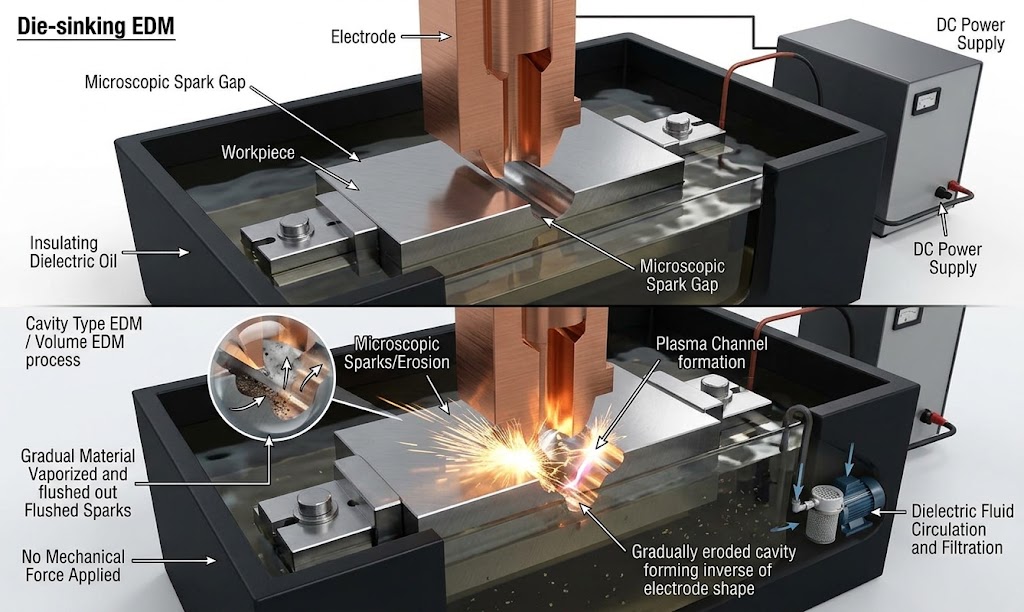
Die-sinking EDM, also called cavity type EDM or volume EDM, consists of an electrode and workpiece submerged in an insulating dielectric liquid — most typically oil. The electrode and workpiece are connected to a suitable power supply. The power supply generates an electrical potential between the two parts.
As the electrode approaches the workpiece, dielectric breakdown occurs in the fluid, forming a plasma channel, and a small spark jumps. This spark removes a microscopic amount of material from both electrode and workpiece.
The process repeats thousands of times per second, gradually eroding the workpiece into the exact inverse shape of the electrode. No mechanical force is applied to the workpiece — making die-sinking EDM ideal for hardened steels and fragile geometries.
| Workpiece Materials | Hardened tool steel SKD11 / SKD61, HSS, carbide, titanium |
| Surface Finish | Ra 0.4–3.2μm (fine finish Ra 0.2μm achievable) |
| Accuracy | ±0.005mm on cavity dimensions |
| Electrode Materials | Graphite or copper |
| Applications | Plastic mold cavities, press die inserts, extrusion dies, prototype cavities |

Sample copper electrodes and finished steel cavity inserts produced by EDM die sinking
EDM Wire Cutting
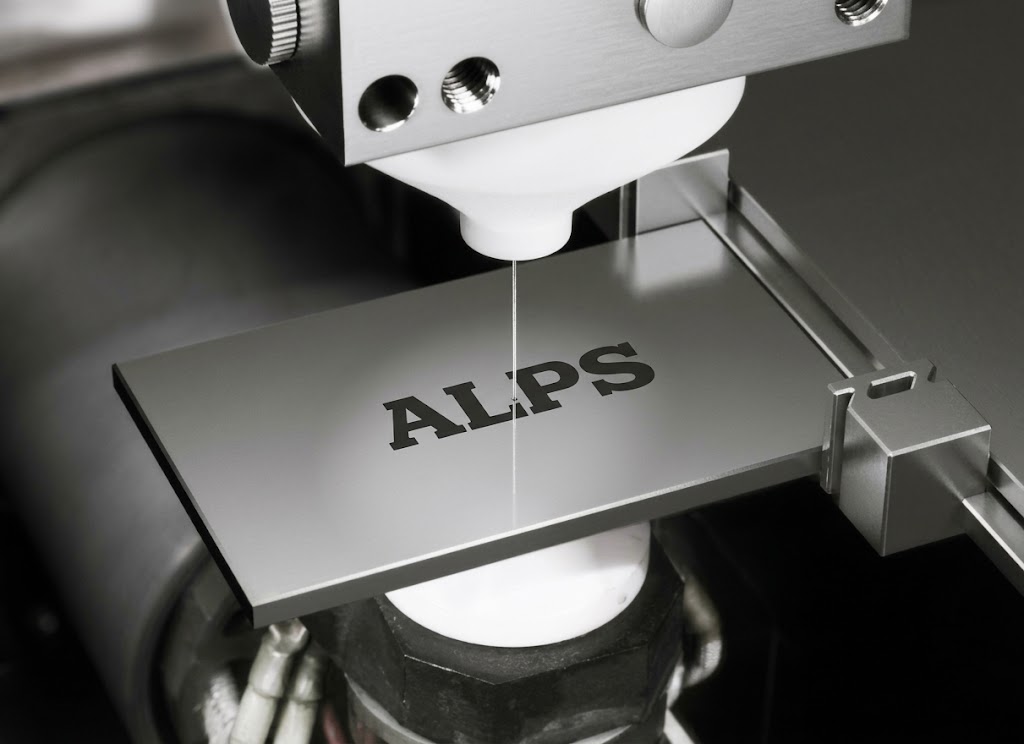
EDM wire cutting uses a thin metallic wire — typically brass or copper, 0.1–0.3mm diameter — to cut a programmed 2D contour through a workpiece by electrical discharge erosion. There is never any mechanical contact between the wire and the workpiece.
Cutting is always through the entire workpiece thickness. The wire can be inclined to produce taper cuts, making it possible to machine parts with draft angles or different profiles at the top and bottom.
Wire EDM is the primary method for producing punch profiles, die openings and blanking dies in hardened tool steel and carbide, as the process imposes no cutting force that could distort the workpiece.
| Wire Diameter | Ø0.1 – 0.3mm brass or copper wire |
| Workpiece Materials | Any electrically conductive material: hardened steel, carbide, titanium, copper alloys |
| Accuracy | ±0.003mm on 2D profile |
| Surface Finish | Ra 0.4μm (skim-cut finish) |
| Taper Cutting | Up to ±15° taper angle |
| Applications | Punch blanks, die openings, extrusion dies, mold inserts, carbide gauges, prototype profiles |
CNC Machining
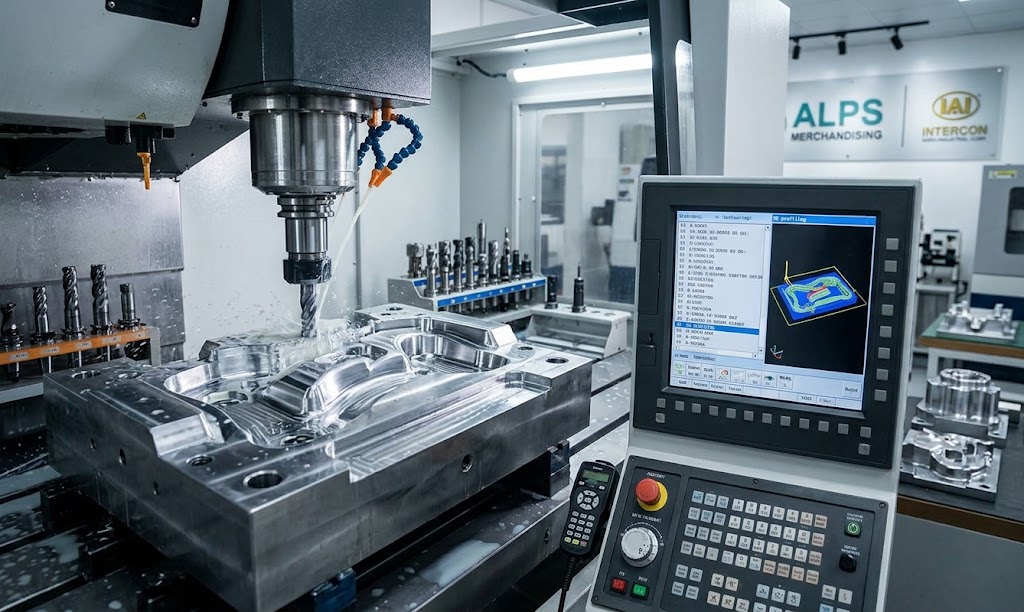
CNC machining uses computer-controlled cutting tools — end mills, drills, boring bars — to remove material from a workpiece and transform it to precise specifications according to a CAD/CAM program.
CNC machines combine a motorized, maneuverable cutting tool with a motorized, maneuverable workpiece table, both controlled by a computer core. Instructions are delivered as G-code, generated from CAD drawings or 3D models, and executed as a sequential program of precise axis movements.
Alps Merchandising operates CNC machining centres capable of producing simple to complex prismatic parts in metal, plastic and composite materials — from one-off prototypes to small production runs.
| Machine Type | CNC Vertical Machining Centre (VMC) |
| Work Envelope | 500 × 300 × 300mm (X × Y × Z) |
| Accuracy | ±0.01mm positional · ±0.005mm repeatability |
| Materials | Steel, stainless, brass, bronze, copper, aluminium, titanium, plastics |
| Operations | Face milling, pocket milling, drilling, boring, tapping, contouring, 3D profiling |
| Applications | Jig plates, fixture bodies, mold bases, frames, brackets, custom machined parts |
CNC Turning
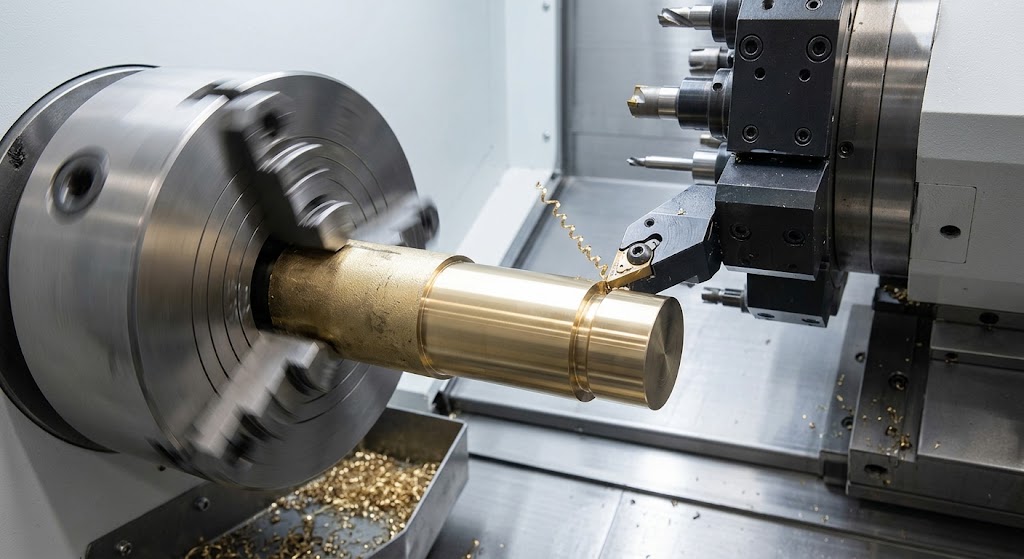
CNC turning is a manufacturing process in which bars of material are held in a chuck and rotated while a cutting tool is fed into the workpiece to remove material and create the desired cylindrical form. This is also called "subtractive machining."
A turret with tooling attached is programmed to move to the rotating bar stock and execute a sequence of facing, turning, grooving, threading and parting operations to produce the programmed result.
Alps Merchandising's CNC turning centres support both turning and live milling — the rotation can be stopped to allow milling, drilling or cross-hole operations on the same setup. This turn-mill capability reduces setups and improves accuracy on complex rotational parts.
| Machine Type | CNC Turning Centre with live tooling |
| Turning Capacity | Ø5 – Ø300mm · Length up to 500mm |
| Accuracy | Diameter tolerance ±0.005mm · Length ±0.01mm |
| Materials | Brass, copper, stainless, carbon steel, aluminium, bronze, titanium, plastics |
| Operations | OD turning, facing, boring, threading (internal/external), grooving, knurling, parting, milling |
| Applications | Shafts, pins, bushings, connectors, fittings, valves, threaded components, custom turned parts |